



“We live in completely different cultures, but we are family. It is worth crossing those bridges and seeing the beauty of it.”
In July 2025, Forest Park Church in Maryland and Fellowship City in South Africa formed an Acts 29 global church-to-church partnership. What began as an opportunity to offer support has grown into a valuable, deeply meaningful relationship—and an extended family.
Read on as Neil Grobler, lead pastor of Forest Park Church; Ryno Meyer, lead pastor of Fellowship City; and Barrett Young, a Forest Park member, share how the partnership has strengthened both churches and made the global church feel personal.
How and when did this Acts 29 global church-to-church partnership begin?
Neil: The partnership began in July 2025. Acts 29 had encouraged North American churches to form meaningful global partnerships. Forest Park had supported missionaries and church planters for many years, but we did not yet have a formal partnership with another Acts 29 church. South Africa was the natural place for me to look. I grew up there, and my heart has always remained connected to the country. After asking Acts 29 for several church profiles, Fellowship City stood out. Our elders prayed, worked through the partnership process, and agreed to begin supporting the church.
Ryno: Fellowship City was planted about four and a half years ago. I completed my church-planting residency at Rooted Fellowship, an Acts 29 church in South Africa, so joining the network was an easy decision for us. As a young church, we knew that local and international partnerships would be important as we grew toward long-term financial sustainability. We first prepared a partnership profile during our 2024 Acts 29 partner renewal. That profile eventually reached Forest Park, and the relationship began.
What are some of the most meaningful aspects of this partnership?
Ryno: The relationship—hands down. We get to know people who are on the same mission in a very different setting. Through Neil, Barrett, their families, and Forest Park, our world has expanded to include a church family in Maryland. Even my children now talk about their “uncles from America.” They understand that people live very far away, yet love Jesus, serve a local church, and share the same mission we do.
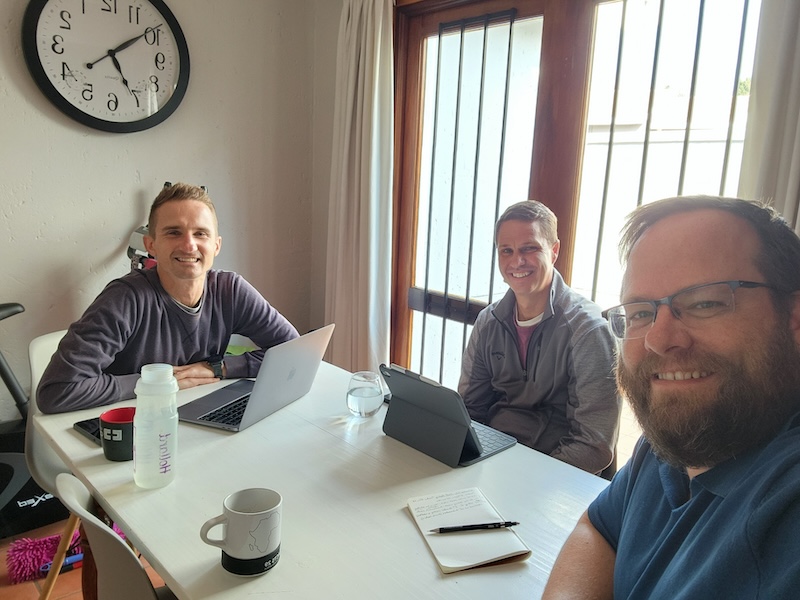
Neil: There is also a remarkable personal connection. Ryno and I grew up about 30 minutes apart in South Africa, are close in age, attended schools that competed against one another, and share the same first language. Our paths almost certainly crossed when we were teenagers, though we did not know each other then. Now we meet monthly—usually in Afrikaans—to share what is happening in our churches, talk honestly about ministry, and pray together. The partnership reminds me that my own ministry context is small, but God’s church is global.
Ryno: Our churches are also similar enough in size, ministry rhythm, and contextual challenges that the relationship is genuinely mutual. We do not have to translate megachurch solutions into small-church reality before we can help one another. We can move quickly to “Have you tried this?” or “Here is a resource that helped us.” That makes the encouragement both practical and personal.
In what ways has this partnership encouraged, strengthened, or supported your church and its mission?
Ryno: Forest Park’s financial support has enabled Fellowship City to do things we could not have done through our internal giving alone. Because the dollar stretches far in South Africa, that support has a significant practical impact—from ministry activity to something as tangible as new chairs for our gatherings. We tell our congregation where that support came from: brothers and sisters across the world who know us, pray for us, and want our church to flourish.
Ryno: More deeply, the partnership has expanded our church’s imagination of what the church is. We often speak about the small-c church and the big-C Church. Fellowship City and Forest Park are local churches, but both belong to the one global Church. The relationship shows our people that churches are not competing for territory or members. We want other churches to win, and they want us to win. They demonstrate that through relationship, prayer, encouragement, generosity, and now a visit. We are in this together. 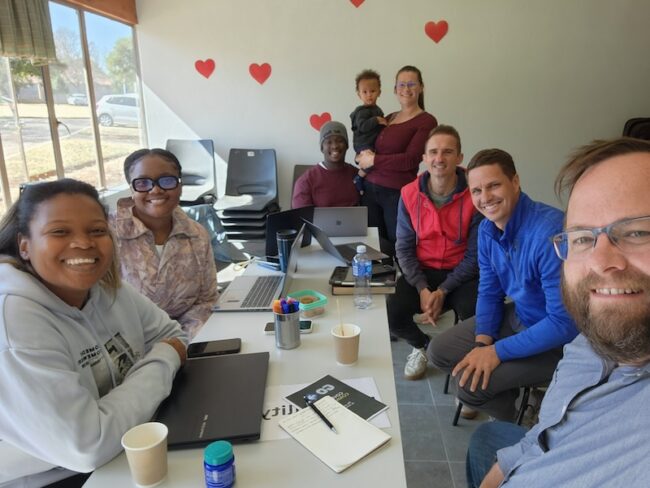
Neil: The encouragement flows both ways. Ryno’s approach to annual planning has sharpened how I think about strategy and alignment at Forest Park. When I needed help putting our small-group leadership practices into words, he shared Fellowship City’s discipleship-group resources and helped get the wheels turning. Our monthly calls are not pass-or-fail status reports. They are honest conversations about what we are experiencing, what God is doing, and where we need prayer. We almost always run out of time.
Barrett: For Forest Park, the partnership has also made global missions personal. We recently created a missions and church planter wall displaying the people and ministries we support. After visiting Fellowship City, those names and faces no longer feel like information on a wall. They represent people, families, and a church we know. The partnership has helped us look beyond our immediate ministry pressures and remember that God’s work is much larger than our own corner of Maryland.
Have you had opportunities to visit one another or serve together? Would you share a memorable story?
Neil: In July 2026, Barrett and I traveled to Pretoria to spend time with Ryno, his family, Fellowship City’s leaders, and members of the church. The visit included meals in homes, ministry conversations, pickleball, time with university students, and Sunday worship. For me, preaching at Fellowship City was especially meaningful. I have preached for nearly 20 years, but this was my first sermon in my home country. I wondered whether I could cross the cultural distance after so many years away. Then I opened with a simple South African greeting—“Howzit?”—and immediately felt at home. 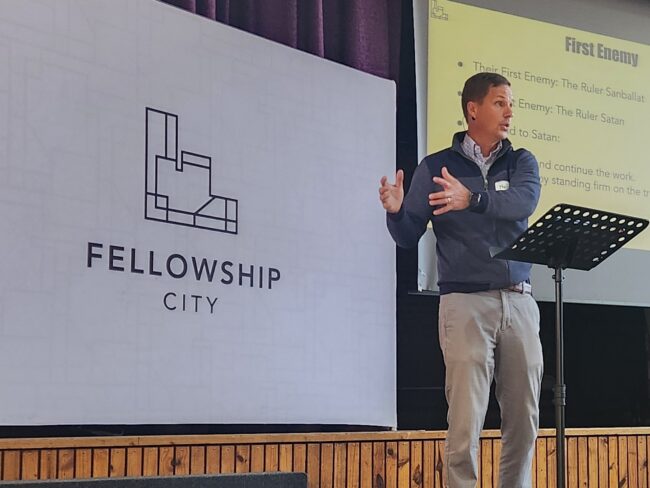
Ryno: One of my favorite moments was a lunch with our ministry leaders built around a game we called “The X-Files.” Everyone submitted an unexpected fact about themselves, and the group had to guess which person each fact belonged to. On paper, it was just a lunch introducing two visitors to our leaders. In practice, the stories, laughter, and vulnerability deepened relationships very quickly. The game was supposed to take about 30 minutes. We ran far over time, and no one cared. Even after lunch ended, people lingered to keep talking. That captured the partnership well: it is not built primarily through formal reports or scheduled meetings, but through people sharing their lives.
Barrett: A defining moment for me came when Ryno took us to a hill overlooking Pretoria and explained why he loves the city and why Fellowship City exists there. He described the church’s calling to embody the gospel’s power to reconcile people across the divisions created by South Africa’s history. That vision became visible throughout the week—not as a ministry slogan, but in the genuine love among people who could easily have remained divided. It helped me see both Pretoria and our partnership more clearly.
Through Acts 29 global church-to-church partnerships, churches build meaningful relationships across cultures, encouraging one another through prayer, generosity, shared resources, and friendship. As Forest Park and Fellowship City have discovered, these partnerships remind local churches that they are part of one global mission to make much of Jesus.